Tuesday, 22 March 2011

"Are you not as a hypocrite, listening to them when you will, and deaf when you will not?"

In our last post, we looked at the importance of doctrine and dogma, not as lifeless, academic concepts, but as ways of coming to know the Truth Himself, Our Lord Jesus. Given that different churches teach different things about Him and His Church, surely we have to ask ourselves which church has the truest doctrines, and therefore the truest picture of Christ.

This is precisely how The Development of Christian Doctrine begins. Bl. John Henry Newman, writing as an Anglican, recounts the inner-monologue he engaged in when receiving Communion from the altar. He affirms his belief in the Real Presence, and then asks himself, "Who told you about that Gift?" He answers that he "learned if from the Fathers." Newman, always eager to give ten examples when two or three will do, gives us a comprehensive selection of quotes from the Church Fathers, testifying to the ancient Church's belief in Christ's Real Presence in the Eucharist. "I cast my lot with them. I believe as they," he concludes.

Yet now his conscience begins to berate him, and is worth quoting at length: "And do not the same ancient Fathers bear witness to another doctrine, which you disown? Are you not as a hypocrite, listening to them when you will, and deaf when you will not? How are you casting your lot with the Saints, when you go but half-way with them? For of whether of the two do they speak the more frequently, of the Real Presence in the Eucharist, or of the Pope's supremacy? You accept the lesser evidence, you reject the greater."
This set Newman to wondering which church, Anglican or Catholic, had the correct doctrine about the papacy, and the correct doctrines in general. A simple appeal to the ancient Church's belief wasn't enough to settle to matter, because hardly any matters were settled in the Church of the first three centuries, in terms of having a defined doctrine; Newman admits that the ancient sources are "scanty" for both Real Presence and Papacy. How was he to account for the variations in belief and practice within the first Christian centuries, and so to find the church of his own day which was the descendant of the one founded by Christ on the Apostles? 
His hypothesis is that "time is necessary for the full comprehension and perfection of great ideas", even, or especially, the divine idea of Christianity, which was transmitted once and for all by inspired teachers but "could not be received all at once by its recipients." Any idea which has power enough to possess and move the hearts and minds of human beings requires "longer time and deeper thought for their full elucidation." To expect an idea to spring up fully formed is unreasonable.

By way of analogy, Newman compares great ideas to a many-sided object, which may be "walked around, and viewed in contrary lights." At first sight, 'smooth' and 'pointed' seem like contradictory ideas, but both can be applied to a table-top, which is flat, and has four or more corners. What seems like evidence of an idea's not making sense could actually be proof of its "substantiveness and integrity," and will appear so once you've found the 'joint' where the two aspects are connected.

Likewise, Newman says, ideas embody the opposite principle of the old saying that 'streams are clearest nearer the source'. Not so with a great idea - it will become clearer, "and purer, and stronger" once it's had time to build up momentum. Silt and dirt sink to the bottom, and life begins to team in its waters once its course is "deep, and broad, and full." In fact, the river, like the idea, must constantly change in order to remain the same. They both must change course to flow around and over obstacles in their path, and even sweep away or cut through them if necessary. If either stick to a straight course, going only in one direction, eventually they meet an obstacle that cannot be overpowered, and become stagnant pools.

With these analogies in mind, what do we find if we look at the 'source' of the Christian 'river', the Bible? We see that it doesn't explain itself: What should be included in the Bible? Is it all of Revelation, or only a part? The Bible is silent on these crucial aspects, and more besides. Given that we can expect developments in the idea that is Christianity, we can expect those areas on which the Bible doesn't pronounce definite teaching to be left to development, and for the Bible itself to have been subject to development, though now fixed.

Further, 'development' as a component of the Divine scheme can be found in the Bible itself. Newman draws attention to prophecy, wherein the idea of the Saviour gradually grows in the mind of Israel, from the one-line protoevangelium of Genesis ("and he will crush [the serpent's] head"), to the "Wonder Counsellor, Prince of Peace" of Isaiah, to his full revelation in the person of Jesus. Likewise, there are ritual, ethical and political developments e.g. God's chosen people go from a family, to a tribe, to a race of people, to a nation.

Clearly, God has no problem working by means of developments; He knows that an all-at-once revelation of Himself would be too much for us, as Newman, and countless saints, have recognised. Yet Newman saw that there was something missing from his description of the process of Revelation. He states boldly, "He who gave Revelation virtually has not given it, unless He has also secured it from perversion and corruption." In other words, if God did not give us some guarantee that the fullest truth about Him would be preserved during this process which all great ideas go through, and therefore be knowable down through the centuries, then He might as well not have bothered! We've seen in the last post the spiritual importance of knowing the Truth, so why would God allow the idea of that Truth, the idea of authentic Christianity, to be lead astray, or die out?

Here is the rational expectation, given what has already been stated, (the "antecedent probability" as Newman calls it), of there being an authority in Christianity which cannot make mistakes about essential aspects of the idea but can always judge correctly between true changes i.e. developments, and false changes i.e. corruptions. Put another way, it's logical to expect an infallible authority in Christianity. Newman acknowledges that Protestants also believe this - for them, it is the Bible. Again, Newman's response to this idea is worth quoting in full:

"We are told that God has spoken. Where? In a book? We have tried it and it disappoints; it disappoints us, that most holy and blessed gift, not from fault of its own, but because it is used for a purpose for which it was not given. The Ethiopian's reply, when St. Philip asked him if he understood what he was reading, is the voice of nature: "How can I, unless some man shall guide me?" The Church undertakes that office; she does what none else can do."

The idea of a living infallible authority, exercised by other human beings, was no more popular in Newman's day than it is in ours, and the objections to it which he deals with sound awfully familiar. For example, 'Doesn't this do away with the need for faith?' might be one. Well, no. Even an absolutely guaranteed truth can be "doubted, argued against, perverted, rejected", just as the Truth Himself was. The process by which the human mind can come to accept such difficult truths/ideas is the subject of another of Newman's famous books, The Grammar of Assent.
What have we learned from Bl. John Henry so far? First, that knowing the truth is essential to having a relationship with the Truth, Jesus Christ, and so is crucial for our spiritual lives. Therefore, following the church which has the fullness of the truth in its doctrines is important. Next, that developments in the 'great idea' which is God's Revelation of Himself through Christianity are to be expected, and can in fact be found. Finally, that one of those developments must be an infallible authority, able to react to changes in the course of the idea, and to promote good developments, and rule out false ones. So far, however, all this is theory, along the lines of 'it is reasonable to expect/conclude that...' In our next post, we'll look at the facts of the case, and see if all these expectations, these 'antecedent probabilities', have actually been fulfilled.

Tuesday, 8 March 2011

"There is no positive truth in religion..."

This past weekend, I was privileged to give a talk at a Catholic Charismatic event on the subject of my great hero, Blessed John Henry Newman. It was the first talk I've ever given, and I certainly learned a lot from the experience i.e. don't try to cram an infinite amount of information into a finite amount of time! The talk was entitled, "Newman and the Impact of Christian Doctrine" and served as an introduction to the beloved Cardinal's insights into the development of the Church's teaching.

This might sound like an abstract subject at best, and a deathly boring one at worst. However, Bl. Newman's life testifies to the dramatic power that Christian doctrine can, and must, have. His most popular prayer book is called Meditations on Christian Doctrine, from which the famous prayer "God has created me to do him some definite service" is taken. Most dramatically, his research for his book On The Development of Christian Doctrine compelled him to become Catholic.

It's hard for us to imagine just how colossal a decision that was for the middle-aged John Henry. As he knelt in his study before Bl. Dominic Barberi on that rain-soaked October night in 1845, and asked the Italian priest to receive him into the Catholic Church, Newman must have reckoned the cost. He paid it dearly. He was ostracized by old friends, and it adversely affected his relationship with his family, to whom he was devoted. His conversion was met by disbelief in the Anglican Church, and even suspicion by some in the Catholic Church. He had to resign his post as a fellow of Oriel College. In later years, he would be attacked in the newspapers and pamphlets (which were widely read, and readily believed) by pillars of English society, like popular author Charles Kingsley, and former Prime Minister William Gladstone.

What did he find in the course of writing Christian Doctrine that he "recognized in himself a conviction of the truth" that the much-maligned Catholic Church was (as we would often refer to it in his later letters) "the one, true fold"? What caused him to undergo the 'bloodless martyrdom' described above?

For a starting point, let's imagine the absurdity of seeing on the news the tragic story that a man has been killed for refusing to deny the statement "2+2=4". Sure, this is a 'truth statement' and the truth is important, but we would rightly balk at the idea of sacrificing our lives for it. Simply put, an abstract, intellectual 'truth statement' isn't important enough for us to risk our lives, or even change them in the slightest. In the modern era, we have this same reaction to the terms 'doctrine' (teaching), and 'dogma' (truth). They're too technical, too distant, to be worth bothering about.

What is important, or valuable, enough  for us to risk the most valuable thing we have? St. Paul says that "perhaps for a good man someone would dare to die." [Rm 5:7] We all have trouble imagining an idea, even one we firmly believe in, for which we'd sacrifice ourselves, but we all have a list in our heads of people who we'd like to think we would die for if the situation arose. We need another person to spur us on to heroic deeds; someone we love, someone who loves us, someone who, one way or another, arouses our passions.

For the Christian, of course, this person is the good man, the God-Man, Jesus Christ. And He is exactly the sort of person we imagine that we'd be prepared to die for. How great He was! All that healing the sick, preaching the Good News to the poor and downtrodden, sticking it to the hypocrites, calling sinners like me "friend", let alone His being prepared to die for me! What a swell guy! Yes, I'd definitely put my life on the line for a chap like that.

Further, throughout the Gospels, and especially in St. John's, Jesus identifies Himself not only with the truth, but as The Truth. He brings out the true meaning of the Law in the Sermon on the Mount. He tells the Apostles that He is "the Way, the Truth, and the Life" [Jn 14:6] and prays that the Father will "sanctify them in truth." [Jn 17:17] by sending "the Spirit of Truth" which will guide the Church "into all truth.".  At last, he tells Pilate that He came into the world "to bear testimony to the truth. All who are of the truth listen to my voice." [Jn 18:37]. Here, He is telling us in a not-at-all subtle way, that the truth is no conceptual, intangible ideal, but is reconciled to the Good Man in His Person. To give up your life for the truth is to give up your life that great guy we described earlier.

And here, of course, I run into a problem. How do I know that Jesus was like that, and said and did those things? He lived 2,000 years ago. Any information I have about Him has been passed on to me by someone else - I have to accept as true someone else's description of Him i.e. their doctrines and dogmas about Him. Even when it comes to praying to Him, the power of which, I might be tempted to think, does away with the need for boring ol' theology by simply 'deepening my friendship with Him' on an emotional level, I first have to know the truths that 1) He is to be prayed to, 2) it is possible to have friendship with Him in spite of the historical gulf between us, and 3) this by His outpouring of grace upon me. All this truth, all this theology, must come from someone else.

As if to make matters worse, I now have another problem. It seems that 'impersonal' doctrines are essential to my 'personal' spiritual life because I can't know anything about Jesus for certain without them. But whose doctrines? There are so many Christian denominations, and each paint their own picture of who my Lord and Friend truly was, and what He meant when He said and did what He said and did. Surely, it would be a disaster to try to build up a true relationship with a false Jesus? We've all seen (and perhaps been in) relationships which weren't founded on the whole truth eventually collapse, and when they do, we think to ourselves, "Well, that was bound to happen." Am I really prepared to put up with that possibility in the most important relationship I'll ever have?

Which brings us back to Newman. Believe it or not, the opening quote is from him. Here it is in context, from the speech he made upon being appointed a cardinal: "Liberalism in religion is the doctrine that there is no positive truth in religion, but that one creed is as good as another." He describes this as the "great mischief" of his time (and ours) to which he had always opposed himself, "to the best of my powers." Simply put, contrary to common opinion, it matters a great deal which church you belong to, which church's doctrines you follow, because you'll be following its 'version' of Jesus, even if you're not aware that's what you're doing. For this reason, the truth or falsehood of doctrines and dogmas is an intensely personal, spiritual matter for Newman, and for us. Where can we find the real Jesus?

In the next post, we'll take a look in more detail at Bl. John Henry's journey towards the Truth.

Wednesday, 26 January 2011

"I can make an image of what I have seen of God...and contemplate the glory of the Lord, his face unveiled."

For a change of pace, I'm not going to be taking our opening quote apart, but affirming it. It is from St. John Damascene, the great 7th-8th century defender of sacred images. If you'll permit me, I'd like to share some of the fruits of my contemplation of a new icon in my parish church, and I hope it will better enable you to draw a spiritual benefit from sacred images.

The use of images, depicting Christ, Our Lady, and the saints, for prayer and teaching is an ancient Christian practice. This picture on the right of a shepherd bearing a sheep on his shoulders (the Good Shepherd), is a fresco from the Catacomb of San Callisto, a 2nd Century Christian burial site in Rome. Such images, constantly employed by the Catholic and Orthodox churches since the earliest centuries, constitute a Biblium Paupares, a 'Gospel of the Poor' "who read in them what they cannot read in books," according to St. Gregory the Great.

It occurs to me (and to my parish priest, who said so explicitly) that too many Catholic churches in this country are more or less bereft of quality sacred images - icons, statues, stained glass, and so on. Correspondingly, we have grown up to be spiritually illiterate, because we can't read these images in a way that earlier generations were able to. With the modern, and admittedly necessary, focus on introducing the laity to the riches of Scripture, perhaps we Catholics have focused on the written word to the exclusion of all the other means in which the Word communicates Himself to us.

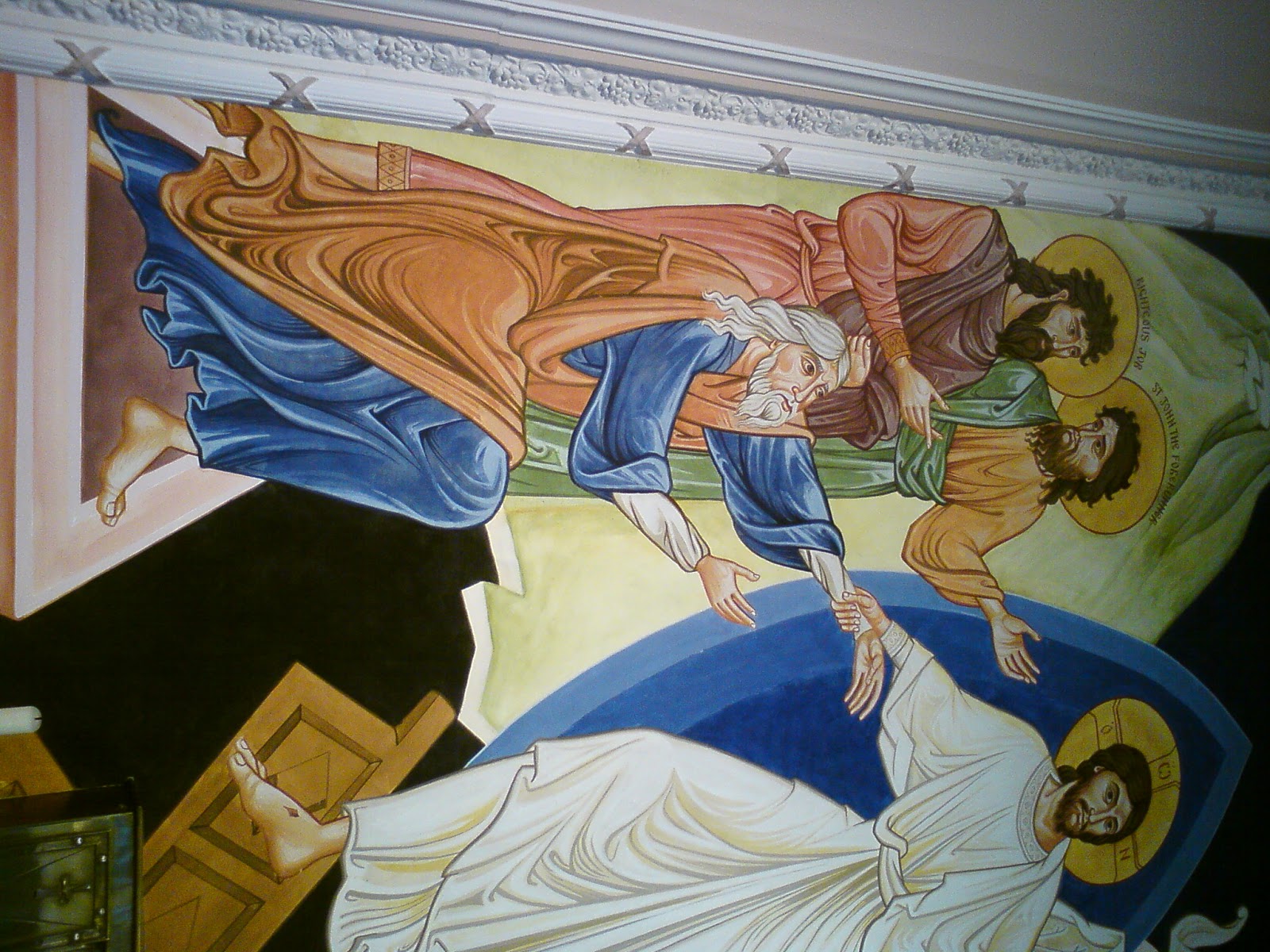
Any of you familiar with Lectio Divina, the practice of praying slowly with Scripture, letting the mind wander over the words, making connections between various passages, and being drawn towards the Truth, will recognise a similar method for praying with icons. Let's begin by taking a look at our new icon, here on the left.

The first thing one notices is the position of the icon, directly above and around the Tabernacle. This is an icon of the Resurrection, and its placement is no accident. That Divine Life which conquers death is not merely an image on the wall, He is present in the Sacrament reserved in the Tabernacle, and our holy communion at Mass is a real share in Christ's own life.

Then we may find ourselves wondering at the figures represented. Who are they, and why are they here? Christ, dressed all in white, is pulling Adam (on the left) and Eve (on the right), from their graves, upon which is written: "Lord by your Cross and Resurrection you have set us free +/You are the Saviour of the World." From left to right, standing over Adam are 'Righteous Job' and 'St. John the Forerunner', while behind Eve are 'Righteous Sarah' and 'King David'. The Gates of Death lie broken under Christ's feet, and under them is the black pit of Hell. The inscription at the top reads: "He has called us out of darkness into His marvelous light."

The first fruit of my contemplation struck me when I was singing the Benedictus from Lauds/Morning Prayer between Sunday Masses. This is the song which was sung by St. Zechariah, the father of St. John the Baptist (John the Forerunner in the Eastern Church), after his power of speech had been miraculously restored. This icon is the Benedictus in picture form! Singing that ancient song, and looking up at this icon, for the first time I could actually see the Lord God of Israel, visiting His people and saving them from the hands of their enemy. I could see the Mighty Saviour who God had promised would come from the house of David His servant, and the covenant He made with Abraham, and His love for Zechariah's fathers (the Jewish Patriarchs, Prophets and Holy Women), being fulfilled. Likewise, I could see the little child, John, who would become a prophet of God Most High, and prepare His way before Him. The Benedictus has never been the same for me since - I see it being acted out in this icon every time I sing it.

Then I realised that there is an even deeper link between the Benedictus, the icon and holy communion. In the English version we use, the Benedictus says "He has raised up for us a mighty saviour", yet what it should say is, "And has raised up a horn of salvation for us," ("Et erexit cornu salutis nobis" as it is in Latin). Why does Zechariah say this? In the Temple, of which Zechariah was a priest, the corners of the altar were turned up into four horns. It was on this altar where the sacrifices for sin were made by the priests, and the flesh of the offerings was shared by priest and people. Before Jesus has even been born, Zechariah, the priest of the Old Covenant, is prophesying the sacrifice of the Divine High Priest of the New Covenant on the altar of the Cross. In the icon, Christ's pierced feet stand astride the Gates of Death, which lie in the shape of a cross behind the Tabernacle, where His flesh, consecrated on the altar, is waiting to be shared by priest and people.

Having explored the composition, I began to notice the colours. Colours are like a special vocabulary in iconography; different colours mean different things. A prominent colour in this Resurrection scene is blue - the sky is a very dark blue, and the mandelion (literally, almond) behind Christ is blue. In iconography, blue is the colour of the divine. God is above all, and present everywhere, even in this place, hence the blue of the sky. I personally like to think of the mandelion as a tear in fabric. Think about it - if you stretch a piece of fabric tight, then slit it in the middle, you'll end up with a tear which is roughly this shape. Here, the fabric of the old created order has been torn open by the death of Christ, and He bursts through to snatch Adam and Eve from death to eternal life through the mandelion, which to me looks like a portal to another world in a sci-fi movie. Except, of course, this one's real. 

So...blue sky; blue mandelion in which stands Christ, a bridge between the Divine and the human [cf. 1 Tm 2:5]. But there is more blue in the picture which I didn't notice at first, because it isn't obviously related to a divine subject. On the left we can see that beneath Adam's brown cloak (brown representing 'earthiness', as in "For dust you are, and into dust you shall return") is a blue tunic, and beneath this are sleeves as white as Christ's! In the picture of Eve it is even more subtle, with barely a glimpse of two blue sleeves beneath another earthy, ochre coloured robe. Adam's brown cloak also looks to me like it's falling away as he is being yanked out of the grave by Christ.

Here, the iconographer, or rather the Church, is reminding us of something fundamental to our fallen, earthly, turns-into-dust-when-you-die nature. Beneath all that, we are truly made in the image and likeness of God. That likeness, which was compromised by Original Sin, is still a part of us, a deeper part than the sins which cling to us like dust and lead to death. Even more fundamental still, this image and likeness of God is not an ethereal, wishy-washy nicety. Perhaps Adam's white sleeves are a sign that we are made in the image and likeness of someone real, the same Someone who now stretches out His scarred, white-sleeved hands towards us. What a source of hope for us in our day-to-day lives, full of struggles and failings and strivings! One of the Prefaces to the Eucharist prays to the Father that He "may see and love in us, what you see and love in Christ." We may be covered by sin, but we are made to be like Christ, like God Himself, and even in the darkest places and times, that likeness lives on.

Further, God will not force eternal life on us. We have to co-operate with His grace. Our efforts, of course, are minimal compared with His, but let's face it, He's much stronger than we are! Our little bit of exertion is puny, but it takes a lot of effort to do even that. This is an important part of our Faith, because it means we must walk the walk, as well as talk the talk - the way we live our lives has an impact on our eternal life (cf. the parables of the Sheep and the Goats, and the Prodigal Son). Adam plants his foot on the edge of the grave, adding his own little strength to Christ's might. 

After all this meditation on what it means to be human, I began to ponder on what it means to be me. I've been exploring my vocation for the last year, and I suppose this was on my mind as I looked at the icon. Blessed John Henry Newman wrote a prayer in 'Meditations on Christian Doctrine' which says, "God has created me to do Him some definite service; He has committed some work to me which He has not committed to another." [March 7, section 2] We all have a vocation, and like much in life, we struggle with it. It occurred to me that maybe if we reminded ourselves that there is something we're born to do, something which is simply a part of us, and this something is given by God, we wouldn't worry about it so much. 

Here, in my parish church, so large you can't miss it, is a colossal reminder about the nature of vocation.  On one side, John the Forerunner does what he was born to do, even here in the afterlife: he turns to Righteous Job, to the people of Israel who've been waiting for the Messiah, and points out to him "the lamb of God". On the other side stands King David, the man God called "a man according to his own heart" [1 Sam 13:14]. Pressure, much? But God gave David everything he needed in order to be that man, and he wears a mantle in God's colour as a sign of His favour.

Praying with icons is a tried and tested method of deepening your relationship with Christ. I hope next time you're in a church you'll take time to gaze up at the icons and statues and stained glass, and savor the Word written in pictures.

Thursday, 30 December 2010

"I'm not a huge fan of the Pope because I don't see the need for one."

As I was eves-dropping from my digital priest-hole into that great digital courtyard which is Facebook, I overheard this assessment of someone's feelings for the Pope. This comment was made on a friend's status. She was sharing her enjoyment of a Pope Benedict-related Christmas present, and wishing everyone a Merry Christmas, when someone began a series of comments beginning with the above statement, all designed to show her "the truth about the whole Catholic church [sic]". It turns out that this guy used to be Catholic, until "God changed my heart and showed me the truth." I think it's a safe guess that he hasn't become Orthodox, because he proceeds to quote a number of passages of scripture, all of which apparently show that the papacy (and 'the whole Catholic church') is, well, needless. And no mention is made of Sacred Tradition, or the history of the Church, which surely an Orthodox christian would have done.

First of all, let's acknowledge that such an action is the height of bad manners. Commenting on someone's 'Merry Christmas' Facebook status to try to prove that their religion is bogus? I think this guy might start by putting down the Bible he's determined to misread (more of which in a moment), and pick up something about being a gentleman from Amazon.

However, if we find ourselves in such a situation, how are we to respond? As usual, there will be a few guiding principles we can apply in pretty much any situation. In this case, our antagonist follows the above statement of personal preference for 'no-popery' by quoting the letter to the Hebrews, in which the divine author describes Christ as "a great high priest" [Hb 4:14], and then 1 Timothy 2:5, wherein the Apostle tells Timothy, one of his disciples and successors in Ephesus, that "there is one God: and one mediator of God and men, the man Christ Jesus." Clearly, this is supposed to be evidence for his statement.

Our heroine (and she is a heroine for making a reply at all) asks what he thinks about Matthew 16:18 - "You are Peter, and on this rock I will build my Church", and correctly points out the flaw in the young man's premise, which seems to be that we don't need a Pope because Jesus is the only high priest and mediator, and the Popes are trying to replace Him. So here's our first principle - examine the premise of their argument. Once you get past the reeled off passages of scripture, what are they actually trying to say? In this case, he was trying to say something which has nothing to do with the passages he quoted. Jesus is the only high priest and mediator? Yeah, we know, and we agree. That does nothing to affect the fact of there being a divinely established papacy or not, does it?

Which brings us neatly to the BIGGEST principle in dealing with these situations. Or rather, the biggest mistake people, Catholic or not, often make. Indeed, our young heroine makes this mistake in referencing Matthew's Gospel, and understandably, because no one has taught her otherwise. Sadly, it seems some Protestants are actively taught to make it. That mistake is quoting Scripture out of context. Selectively quoting isolated passages of Scripture is good for nothing. Nothing. Even the Enemy does that for his own infernal purposes [Mt 4:6]. The real skill is reading each part of Scripture in unity, in harmony, with the other parts, whether it's the previous or subsequent parts of the same chapter, or book, or a different book. This is something urged by Pope Benedict in his document on Scripture [which is very long, so this is a summary]. When we do this, we discover what the Holy Spirit intended.

A prime example is the Devil's own misreading of Psalm 91 in Mt 4:6. After his selective verse about the angels bearing Jesus in their hands lest He strike His foot against a stone, if Satan was to quote the next two lines, he would see what God has in store for him - "On the lion and the viper you [Jesus] will tread, and trample the young lion and the dragon." It's not too much to suppose that, in fact, this passage of the Old Testament is fulfilled when Christ refuses to throw himself from the Temple tower - he doesn't put His Father to the test, and so does indeed go on to trample the dragon on the Cross.

Let's do the same thing with the quote from 1 Timothy 2:5. Yes, Jesus is the one mediator between God and men. A mediator is someone who makes peace. Yet St. Paul also says at the start of 1 Timothy 2, that he desires the church over which St. Timothy has authority to make "prayers, supplications, intercessions, and thanksgivings for all men" and especially those in authority, so that "we may lead a quiet and peaceable life." He then explains where this peace comes from in the passage already quoted - from Jesus Christ, the one mediator. So the Apostle connects the actions of the Church (offering prayer, fasting, thanksgiving [eucharistia!]...for peace) with the action of Christ (making the peace for which they have prayed). Therefore, while Christ is the only mediator, the Church is an intercessor for the whole world, and can effect its peace.

What do find if we widen our context to the whole of this letter? St. Paul is giving St. Timothy fatherly guidance on how to organise the church, and what to teach them, including a warning against false teachers. The letter reveals that Timothy has this authority because grace was given him "by prophecy [in some translations 'by the prophets' i.e. Apostles], with imposition of hands of the priesthood." [1 Tm 4:14]. Grace, of course, is a spiritual reality, coming from God through the Holy Spirit, but St. Paul is making it clear that this gift of grace can be given by the Church's elders/bishops by the laying on of hands. The Apostles do exactly the same with the seven Deacons in the Acts of the Apostles [see Acts 6]. So, the Bible is plainly telling us that the Apostles can give their authority to others. This authority is not merely a worldly authority, or status, but an authority backed up by the Holy Spirit. For Catholics and Orthodox, this is an early example of apostolic succession, where by the Apostles could hand on their authority to successors, in an unbroken chain down to the bishops of our own day.

So, now it's reasonable to ask where did the Apostles get their authority to direct the prayers of the Church, appoint successors with spiritual power, and determine what is authentic Christianity in terms of faith and morals, which is also covered in the letter to St. Timothy? According to the Bible...from Jesus Himself! When we read these passages from the Gospels, it is obvious that the Apostles have no authority of their own, but that Christ is sharing His own authority with them. A great example is Luke 10:17, when the 72 disciples come back from their mission to the surrounding towns. Rejoicing, they tell Jesus, "Lord, the devils also are subject to us in your name. [emphasis mine]" As if a core group of disciples imitating Christ by casting out demons isn't explicit enough, the Lord says to them, earlier in chapter 10, "He that hears you, hears me. He that despises you, despises me. And he that despises me, despises the one who sent me." He also shares His power to forgive and retain sins in John 20:21-23, and declares, "Just as the Father sent me, so am I sending you." It seems that Jesus was keen for the Church to continue doing His work after He'd returned to the Father.

Our final example will eventually widen our context into the Old Testament as well. In the Matthew's Gospel verse that our heroine quoted, a longer passage shows us something very important regarding the Church's authority. After Simon, brother of Andrew, had confessed that Jesus is the Christ, "the Son of the living God," Jesus says to him, "You are Peter, and on this rock I will build my church, and the gates of hell shall not prevail against it. I will give you the keys of the kingdom of heaven. And whatsoever you bind on earth, it shall also be bound in heaven; whatever you loose on earth, it shall also be loosed in heaven." This is the most familiar passage in this dispute about the nature of the papacy, and is the key to understanding it. Or rather, this is the lock, and we need a key to unlock it to reveal the full meaning.

Jesus here is making a reference, almost word-for-word, to Isaiah 22:20-22. In it, God gives the King's authority to Eliacim, so that he can be "a father to the inhabitants of Jerusalem [the holy city], and to the house of Juda [the king's tribe]." Effectively, God is appointing a steward to govern in the king's name. He is definitely not trying to replace the king! The key passage (sorry for the pun) is this, "I will lay the key of the house of David on his shoulder: and he shall open, and none shall shut: and he shall shut, and none shall open." Click! That's the sound of the lock of Matthew's Gospel opening. Is it not painfully obvious that Christ is likewise appointing a steward to govern his people (the Church) in his name, and to be a father to them? Just as the stewardship of Jerusalem was passed on from one steward to the next, so has St. Peter's authority been passed on from one Pope to the next. Such a blatant reference to the OT would not have been lost on the Jewish readers of Matthew's Gospel.

Further to this important passage, Jesus also prays for Peter so that he can strengthen his brothers, that is, the other Apostles [Lk 22:31-32], and after His Resurrection asks him to "feed my lambs" and "feed my sheep" [Jn 21:15-17]. Jesus doesn't give these tasks to any of the other Apostles, unlike the power to forgive and retain sins which the Apostles share.

Before we finish, let's tackle a strange assertion the antagonist makes regarding Peter as the rock. His response to our heroine's quote was to claim, "Jesus Christ, our Lord and Saviour is the only rock on which the church is built. The LORD alone throughout the whole bible is called the rock." He proceeds to quote from a couple of Old and New Testament passages, which do indeed refer to God/Christ as a foundation, a corner stone, or a rock. Of course God is the Rock, Foundation and Cornerstone! But this does nothing to diminish, and everything to exalt, the authority of the Church, with which He chose to share that power. 

As for the notion that only God is referred to as rock, foundation, etc...well, that's not what the Bible says, is it?  What about Ephesians 2:20, where St. Paul says, "You are part of a building that has the apostles and prophets for its foundations, and Christ Jesus himself for its chief cornerstone."? If Christ is the chief cornerstone, doesn't that mean that there are other cornerstones? Yes it does, according to Revelation 21:14, where the 12 Apostle's names are carved into the cornerstones of the heavenly Jerusalem. The Lord doesn't even reserve the authority to judge to Himself, but promises the Apostles that they will sit with Him in His majesty, on twelve thrones to judge the twelve tribes of Israel [Mt 19:28]. Oh...and not to forget the passage where God Himself gives Simon a new name by calling him Rock!


It seems like we can only conclude that Jesus was taught to share with others as a boy. He shares His authority with the Church through the Apostles, who can cast out demons, offer right worship to God and intercede for the world, are definite channels of grace to others, can forgive sins, determine the boundaries of authentic Christian living, and support the Church as its foundation, and appoint their own successors. In addition, St. Peter is called to govern the Church as a steward, and strengthen the faith of his fellow leaders. All of this power comes from Christ, so that people can be lead to Christ. 

Now, it's important to recognise that the Lord didn't have to do any of this. He could have converted the whole world by Himself, which would have been particularly easy after His Resurrection. However, He chose to do it the way we've examined so as to share His glory with us (as is clear from the Mt 19:28 passage). Any of us may think He acted unnecessarily in doing so, but He also acted unnecessarily in redeeming us, though I'm glad He did. As such, I think it would be a good idea for this young man to heed his own advice, and pray for guidance, confident that if he knocks, the door will be opened, because we know who's holding the keys.

Saturday, 11 December 2010

"The Pope's invitation to Anglicans to convert..."

A while ago I coined a term for my own amusement: 'Journalisma'. Think of it as a combination of asthma and eczema, except it only afflicts journalists. Its affects are simple - it cuts off oxygen to the journalist's brain, leaving them short of breath facts (which is the asthma part), and spreads like an irritating rash, in that it can be found in multiple media outlets (the eczema part).

With this is mind, I'd like to draw your attention to a recent outbreak, this being one case among many.The above quote wasn't said by anyone I was talking to, but is how an article on the BBC News website begins. Inspired by the excellent work of the journalists on the Get Religion blog, I thought I'd take a swing at deconstructing the article to show you Catholics how much "the press...just doesn't get religion" and to show a few things you will have to point out when people start conversations with, "I read in the papers the other day that the Pope..."

It seems a common mistake (trick?) of journalists is to muddle up the process of who-talked-to-who-first. Indeed, this article begins with a clanger: "The Pope's invitation to Anglicans to convert to Roman Catholicism..." Can you see it? The Pope's invitation. Doesn't this make it sound like the Pope called the disaffected Anglican bishops and said, "Come and join us."? In fact, the Pope didn't initiate anything; the Anglican bishops from England and Australia went to Rome and asked for a way to convert as a community, rather than individually. The Apostolic Constitution 'Anglicanorum Coetibus', which sets how this is to happen, begins, "In recent times the Holy Spirit has moved groups of Anglicans to petition repeatedly and insistently to be received into full Catholic communion..." Get that, BBC? They petitioned Rome 'repeatedly and insistently'!

This, of course, is all of-a-piece with the British media's general handling of this story [see this headline and this headline for more Journalisma, although the Times article at least gets the sequence of events straight. Perhaps misleading headlines is another symptom of the illness].

The main part of the article is about a cable communication by the US Ambassador to the Holy See, in which he reports some comments of 'our man in the Vatican' Francis Campbell. Mr Campbell said to his American opposite number, Miguel Diaz, that the Pope "had put [Archbishop of Canterbury] Williams in an impossible position." As you'll see from the BBC article, this is reported without comment, so I'll add a few of my own.

"An impossible position." I agree, Dr. Williams is in an impossible position, which is none of the Pope's doing, but his own Church's. The article's lack of context to the issuing of Anglicanorum is the problem here, and is another symptom of Journalisma. It doesn't ask why those Anglican bishops petitioned Rome in the first place (which means that you should if anyone brings it up!). They want to become fully Catholic because they foresaw the result at the General Synod earlier this year, when a compromise, proposed by Dr. Williams and the Archbishop of York Dr. John Sentamu, for the Anglo-Catholic communities to have only male bishops was rejected. These Anglo Catholics now either have to accept the authority of women bishops, or leave the Anglican Church [see their statement in the Guardian]. It was for this reason that the bishops in the Traditional Anglican Communion (TAC) went to Rome and asked for support in converting as a group, and the Pope has helped them.

So...to return to our point. Who's fault is it that Dr. Williams is in this position? Not the Pope's, anyway. That this statement comes from the first Catholic British Ambassador to the Holy See since the so-called Reformation is very upsetting, but not the subject of this post. However, the anonymous journalist simply reports the statements as fact.

Another symptom of Journalisma, at least when it comes to the Catholic Church, is to 'go all in'. By this I mean that the oxygen-deprived journalist appears to think, "Well, I'm writing a story about the Catholic Church anyway, so I might as well flesh it out with stories about child abuse, and anything else I can find to damage it's credibility." Ergo, this story finishes with more Wikileaked cables about the abuse in Ireland, and a somewhat confused section about how the Vatican "helped secure the release of British sailors...in April 2007". Or not.

This last part is interesting, because clearly it sounds too much like positive news re: the Church, so the journalist oscillates between reporting that an official (whether Vatican or American is unclear) told Pres. Obama in a report that the Vatican can act as an intermediary in such cases, to saying that the same official was "unclear how much clout the Vatican has with Iran", to affirming that the Vatican did help secure the British sailors' release, and finishing with it is unclear how influential the Vatican was in this case. Confused? Me too. Surely we can conclude that, however influential or not the Vatican may be in Tehran, it is at least influential enough to secure the release of British sailors. Why the need to repeat the same contradictory statements twice?

So, there you have it. Look out for these four symptoms of the dreaded disease: 1) muddling up of facts, especially timelines; 2) misleading headlines; 3) lack of context; and 4) throwing everything at the Church in the hope that something sticks. Happy diagnosing!

Sunday, 14 November 2010

"Preach at all times, and if you must, use words."

How many times have you heard this said? It seems to be a favourite among Catholics, not least because of its association with that most beloved of saints, Francis of Assisi. As 'Franciscan' as it may be in spirit, particularly when we see St. Francis' dedication to the poor (preaching through deeds) as part of the same evangelisation effort as his friend St. Dominic's dedication to preaching, this phrase does present us with some problems.

Setting aside the great difficulty of actually attributing this quote to St. Francis, and the fact that St. Francis was himself a gifted preacher, it embodies an attitude to talking about our faith from which the laity in England suffer a great deal. I wonder whether it is a particularly English problem ('stiff upper lip' and all that), which prevents us from talking openly about the things which are important to us. It is certainly a modern problem, because society-at-large is uncomfortable with the idea of objective truth. When Catholic Christians talk about their faith and their religion, what else are we doing but asserting that there is a Truth and sharing it (Him)?

Ergo, Catholic's can safely hide behind this Franciscan apocrypha and say, "Ah well, St. Francis said you should only use words if you need to." I know that's not what the quote says, but how else are we to read that "and if you must"? Surely, it can only be taken to mean that using words is a last resort, something to be begrudgingly wheeled out when all else has failed? In practice, it's far easier to say nothing, even in the direst circumstances, and save yourself the rejection and ridicule.

The Catholic Church, however, takes a markedly different view. All the baptised share in Christ's three offices of priest, prophet, and king. It is as baptised prophets that we are to evangelise the world. How? The General Catechism says:


905 Lay people also fulfil their prophetic mission by evangelization , 'that is, the proclamation of Christ by word and the testimony of life'.

The paragraph then says that this double evangelisation by word and deed is 'peculiarly effective' through the laity because it is carried out in the ordinary comings and goings of daily life. People are going to hear our joy and see our holiness not just at church, but at home, work, gym, pub, on the street, and so on.

So far, so standard. But here's where it gets interesting. There is a quote immediately after this from Vatican II's document on the role of the laity, Apostolicam Actuositatem, which reads:

"This witness of life, however, is not the sole element in the apostolate; the true apostle is on the lookout for occasions of announcing Christ by word, either to unbelievers...or to the faithful." [abbreviation in the Catechism].

Do you see what's so unusual about this? We have already had a passage telling us to evangelise through word and "testimony of life". Why, then, did the bishops who compiled the CCC feel it necessary to go back and underline that it is the duty of the laity, as 'true apostles', to be "on the lookout for occasions of announcing Christ by word"?

In all honesty, I have no idea, but clearly they were following the same thinking of the Council Fathers who wrote Apostolicam 30 years before. In it, the Bishops of the world exhort us, the People of God, to "be more diligent in doing what they can to explain, defend, and properly apply Christian principles to the problems of our era in accordance with the mind of the Church" [AA 6§3] each according to our own ability and learning. Clearly, they saw that if true faith in Christ was to flourish and not be overcome by the "very serious errors" of our era, then the laity, now better educated than at any point in Church history, should play a pivotal role.

This thinking regarding the essential role of the laity could well have been influenced by Blessed John Henry Newman, sometimes called 'the Father of Vatican II', who 90 years before the Council wrote, "I want a laity...who know their religion, who enter into it, who know just where they stand, who know what they hold, and what they do not, who know their creed so well, that they can give an account of it, who know so much of history that they can defend it." [Present Position of Catholics in England, pg 390]

Bl. John Henry, Vatican II, and the Catechism all agree - we, the laity, have a special role, a 'peculiarly effective' role in bringing people into contact with Jesus, and it is especially important that we do this by explaining, reasoning out, and defending the Faith verbally. In other words, by preaching.

Yet all three sources are united in one other aspect. They all presuppose that Catholics are already living the Christian life, and making the Gospel present in the world by the way they live. Earlier in Present Position, Newman comically points to the effect 'testimony of life' will have: "...the Manchester people will say, 'Oh, certainly, Popery is horrible, and must be kept down. Still, let us give the devil his due, they are a remarkably excellent body of men here, and we will take care no one does them any harm.'" [Present Position, pg 387]

Likewise, Apostolicam reminds us to "let your light shine before men, that they may see your good works, and glorify your Father who is in heaven." [Mt 5:16]

So it seems to me that the quote which began this post isn't entirely wrong, but it is missing a huge part of the picture. The fuller way of preaching the Gospel proposed by Newman and Vatican II is to ensure, first of all, that we live holy lives, and continue to do that which the laity has always done i.e. bring a Christian way of being and behaving into everyday activities, and other people's lives.

Then, we must tell people why we do what we do; that it isn't a matter of personal preference, but principles held in common by a worldwide society called the Catholic Church. Let us not be afraid to announce Jesus Christ in conversation, because as He said in today's Gospel, "I will give you a mouth and wisdom, which all your adversaries shall not be able to resist and gainsay." [Lk 21:15]

Tuesday, 9 November 2010

"Would you say the Old and New Testaments are two stories, or one? I don't want to upset anyone."

It's been long observed that there are no new heresies. Like weeds, they just keep growing back, and while it may look like a different plant, it's the same one as before, with the same roots. See this great breakdown of quite a few old bad ideas.

The one alluded to in the above question, which is based on the idea that the Old and New Testaments are radically different, 'two stories rather than one', is practically the oldest, and is called Marcionism, after the heresiarch Marcion. He first proposed, in the 2nd Century, that the Old Testament was inspired by a completely different god, who was violent and vindictive, from the Father of Our Lord who is the source of Love, and so was to be rejected as having nothing to do with Christ. What makes the question above even more startling is that it I was asked by someone who professes to be a Christian. To be fair, it didn't seem to be their opinion, but they didn't want to upset any 'higher-ups' in their church because they're applying for ministry jobs. I know...that's actually worse, that those in charge of this church could be upset at the idea of the second half of the Bible being somehow related to the first. So much for being 'Bible Christians' eh?

Now, it's unlikely that you'll hear this from a Christian, but it is a common objection from people like Christopher Hitchens, who called Marcion a 'Church Father' (wrong!) in a Channel 4 documentary on the Ten Commandments presented by Anne Widdicombe. What are we to say to this idea, that the God of the OT is cruel and unusual, and the God revealed in Christ is a completely different, much nicer, God?

First, and most important with a lot of heresies, is to point out that it is, in fact, centuries old. Marcionism is almost as old as Christianity itself. So ask, do they really think they're the first person to have 'noticed' that the OT is somewhat different from the NT? Do they also think that no Christians have taken a crack at trying to explain that difference in the last 1,900 years? I suppose we can only hope that their answer is "No."

This brings us to an important principle in apologetics and evangelisation - famously stated as "to study history is to become Catholic." Blessed Newman exhorted his audiences in 'The Present Position of Catholics in England' to "know so much of history that they can defend it." Just as the error is ancient, so is the answer. One of the great things about being Catholic is that you don't have re-invent the wheel when it comes to answering these questions; someone probably wrote a great answer over a thousand years ago.

Which brings us to St. Irenaeus of Lyons, one of the early Fathers of the Church. He was from Asia, but became bishop of Lyons in France, and wrote one of the earliest works of Christian theology called Adversus Haereses, 'Against the Heresies'. He was writing in the middle of the 2nd Century, around the same time as Marcion was spreading his new ideas. Irenaeus deals with Marcionism in a very clear and logical way, espcecially in Book IV, Chapters 32 and 34 (don't worry, they're quite short. Such was Irenaeus' precision when dealing with falsehood!).

In Chapter 32, he relates that a priest who was a disciple of the Apostles, taught his students what the Apostles had taught him i.e. that both testaments (that is, covenants between God and man, and the documents which record them), are given for the good of mankind. The "first testament was not given without reason...[but] foreshadowed the images of those things which exist in the Church...and contained a prophecy of things to come." St. Irenaeus' source, as well as his teaching, is important. Bl. John Henry observed in his studies of the Church Fathers that they primarily relied on Sacred Tradition, the teaching handed on by the Apostles, to refute error, rather than passages of Sacred Scripture because the heretics themselves used Scripture as proof of their false ideas [see Newman's note 2 at the bottom of the page]. Logically, if it didn't come from the Apostles, it didn't come from Christ and the Holy Spirit, and was therefore made up.

Irenaeus does of course use passages of Scripture in defence of the Apostles' teaching. After all, if the point being advanced is the radical disticntion between OT and NT, 'old god' and 'new God', it would be important to demonstrate their unity from the texts in question. In Chapter 34, following on from his point in Ch. 32 regarding the prophecy of the OT, he rhetorically asks the Marcionites who the prophets were announcing if not Christ. If they were inspired by a completely different god as Marcion taught, they must have been anticipating the life of another person, who was a just king, who suffered, died and rose from the dead, while the same events also transpired in the life of Jesus! Clearly, this doesn't hold water. Not content with plain logic, he illustrates the case with quotes from the prophets, the Apostles' letters, and this coup-de-grace from the Lord Himself: "Think not that I have come to destroy the law or the prophets; I came not to destroy, but to fulfill," [Mt 5:17]. Again, if Jesus was the Son of a different God from that which gave the prophets their mission, why would He not come to destroy them and their cruel laws from their cruel God, rather being born a subject of that law?

Once more, we are led to an indispensable principle when trying to unpick any similar difficulties - "What Did Jesus Say?" or WDJS, for short. Alright, I made up the anagram, but the principle still applies. I suppose this is why you're not likely to hear this 'two separate stories' theory from a Christian, because they should know what Jesus thought and taught about this. Further to St. Irenaeus' example, this sprang to my mind from the end of St. Luke's Gospel: "Then he said to them: 'O foolish and slow of heart to believe in all things, which the prophets have spoken. Ought not Christ to have suffered these things and so enter into his glory?' And beginning at Moses and all the prophets, he expounded to them in all the scriptures the things that were concerning him." [Lk 24:25-27, emphasis mine].

Seems pretty clear, right? Without doubt, there are things which are unpalatable or unsavory in the Old Testament to our modern tastes, just as there were to Marcion's tastes, but we risk making a mockery of Christ's mission of love (for He did not need to save us, or prepare us to be saved) if we reject the Old Testament out of hand. Let's encourage those who shy away from embracing the whole Truth, whether Christian or not, to see the object of all the Scriptures for who He really is-  the God of Abraham, Isaac and Jacob, made flesh and dwelling among us.